
Freight Forwarding Job Costing in the UAE: Quote-to-Margin Controls
By Valusage Technical Practice
Editorial responsibility: Valusage Business Advisors Editorial Practice
Direct answer
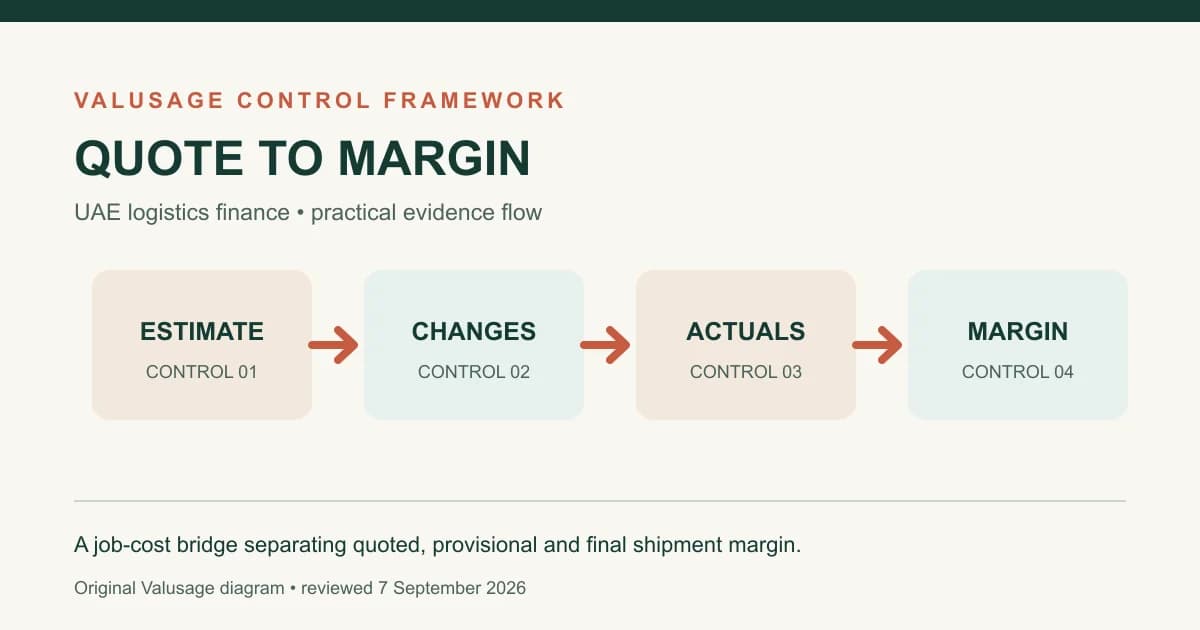
Freight-forwarding job costing in the UAE should start with an approved quote and assign every expected and actual revenue or direct-cost line to one governed shipment reference and charge code. Finance should compare quote, booking and actual economics; accrue evidenced costs that have not yet been invoiced; test billing completeness; separate provisional from final margin; and retain a clear bridge for currency, quantity, route, accessorial and commercial changes.
Decision graphic
Freight job-cost bridge from quote to final margin
Model architecture
Sensitivity heatmap
Decision table
Classify a freight job’s margin status
| Job condition | Margin label | Required action |
|---|---|---|
| Quote approved; movement not complete | Forecast | Maintain expected revenue and cost |
| Service complete; bills or charges outstanding | Provisional | Accrue evidence-based costs and test billing |
| Material dispute or missing document | Exception | Assign owner and block finalisation |
| Billing and cost completeness approved | Final | Lock result and retain reconciliation |
A shipment can look profitable because a carrier bill has not arrived, because a destination charge was omitted from the quote or because revenue was recorded while costs remained outside the job. Reliable job costing makes those timing and completeness risks visible before management prices the next shipment.
This guide supports the UAE logistics accounting pillar and connects to carrier-invoice reconciliation and the shipment profitability dashboard.
What should an approved job-cost baseline contain? Capture customer, shipment, service mode, origin, destination, route, Incoterms where relevant, currency, quoted revenue, expected carrier and agent costs, accessorial assumptions, validity period, tax assumptions and target contribution. Preserve the approved version and approver.
Do not overwrite the quote when the booking changes. Record a versioned amendment with reason, commercial owner and customer approval where required. This allows finance to distinguish estimation error from an operational or customer-requested change.
Which costs belong to the shipment? Map direct carrier, agent, terminal, handling, documentation, inspection, delivery and other job-specific costs under an approved charge-code catalogue. The company’s policy should define what is direct, shared or overhead and how shared charges are allocated.
A charge belongs to a job only when the supporting service and reference agree. Do not force unrelated differences into a profitable shipment merely to clear a suspense balance.
How should estimates and accruals be controlled? Compare the expected-cost register with bookings, rate confirmations, operational completion and received supplier bills. For evidenced services received but not yet invoiced, calculate an accrual using the approved accounting policy, identify the basis and owner, and reverse or true it up systematically.
An estimate should retain supplier, shipment, charge code, currency, basis, service date and expected invoice date. Old accruals, repeated manual overrides and estimates without operational evidence are review exceptions.
How should foreign-currency effects be separated? Store quote, booking, invoice and settlement currencies and applicable approved rates. Separate commercial rate variance, quantity variance and accounting currency movement where the data permits. Do not describe all differences as exchange loss.
The job view should show both transaction currency and reporting currency. Finance should reconcile the job-level bridge to the foreign-currency ledger under the approved policy.
How is billing completeness tested? Create an expected-charge checklist from the approved quote and amendments. Compare it with customer invoices and credit notes once operational criteria for billing are met. Investigate jobs completed but not billed, charges quoted but omitted, charges billed without evidence and post-close invoices.
A bill-ready control should require a complete document set appropriate to the service, not merely an operations status flag. Exceptions remain open until billed, waived under authority or otherwise resolved.
When is shipment margin provisional or final? Margin is provisional while material customer charges, supplier bills, customs-related amounts, accruals or disputes remain unresolved. Define objective finalisation conditions and block silent closure when required items are open.
Reopened jobs should retain the earlier close date, reason, approver and financial effect. The dashboard must distinguish final margin from a forecast or provisional estimate.
How should VAT and Free Zone questions be handled? Tax treatment depends on the actual service, route, parties and evidence. Do not infer VAT treatment from an air, sea, road or courier label, or from whether a charge was included in a quote. Link each tax decision to current FTA material and valid documents.
The FTA’s Free Zone Persons guidance includes logistics services within a wider qualifying-activity framework. Eligibility remains conditional and should not be translated into an automatic rate for a job or company.
Which job-costing exceptions matter most? Prioritise negative or below-threshold margin, actual cost without quoted recovery, revenue without cost, cost without revenue, old accruals, missing supplier bills, duplicate charge codes, jobs with no commercial owner and unusual manual journals.
Use accounts payable controls for supplier governance and the month-end close checklist for period control.
Professional boundary This is a finance-control framework, not revenue-recognition, tax, customs, freight, legal, sanctions, trade-compliance or assurance advice. Recognition and classification must follow the contract, evidence and the entity’s approved accounting policies.
Continue the decision
Services, evidence and next steps
Related control guidance
Continue with another evidence-led management review
 Accounting and BookkeepingConsignment Inventory Ownership, Count and Settlement Controls in the UAE →
 Accounting and BookkeepingMaintenance Work Order, Service Receipt, Accrual and Invoice Controls in the UAE →
 Industry GuidancePromotional Discount, Coupon and Co-Funding Reconciliation Controls in the UAE →
 Industry GuidanceReturnable Packaging, Crate and Pallet Deposit Reconciliation Controls in the UAE →
Professional boundary
This article is general information. It is not a filing opinion, legal advice, audit conclusion, investment recommendation or guarantee of authority acceptance or commercial outcome.
What is the minimum job-costing baseline for a freight forwarder?+
An approved quote, shipment reference, charge-code list, expected revenue and cost, currencies, route assumptions, target margin and version-controlled amendments.
Can a shipment margin be final before every carrier bill arrives?+
Only if the approved close policy supports reliable, evidenced accruals and all material billing and cost-completeness tests are resolved.
Should quote-to-actual differences all be called exchange variance?+
No. Separate rate, quantity, route, accessorial, commercial and currency effects when the evidence allows.
Valusage email updates
Receive related Valusage guidance
Original summaries with official sources and practical context. Confirm by email. Unsubscribe at any time.
Relevant next steps
Connect this guidance to a defined requirement
Contextual advisory review
Control quote-to-margin by shipment
Describe the entity, decision, deadline and evidence available. The service, enquiry and article path accompany the request. No engagement begins until scope, responsibilities, timing, exclusions and fees are agreed in writing.
Review the related service →Contextual enquiry
Control quote-to-margin by shipment
Tell us the outcome, deadline and current position. The selected service context is retained with your request so the right scope can be reviewed.