
Carrier Invoice Reconciliation for UAE Logistics Companies
By Valusage Technical Practice
Editorial responsibility: Valusage Business Advisors Editorial Practice
Direct answer
Carrier invoice reconciliation for a UAE logistics company should match each supplier bill and statement line to the approved carrier, shipment, booking, service date, route, charge code, currency and rate agreement. Finance should detect duplicate invoices, unexplained accessorial charges, quantity or weight differences, missing credit notes and unrecorded liabilities; then reconcile approved bills to payments, supplier statements and the general ledger before shipment margin is treated as final.
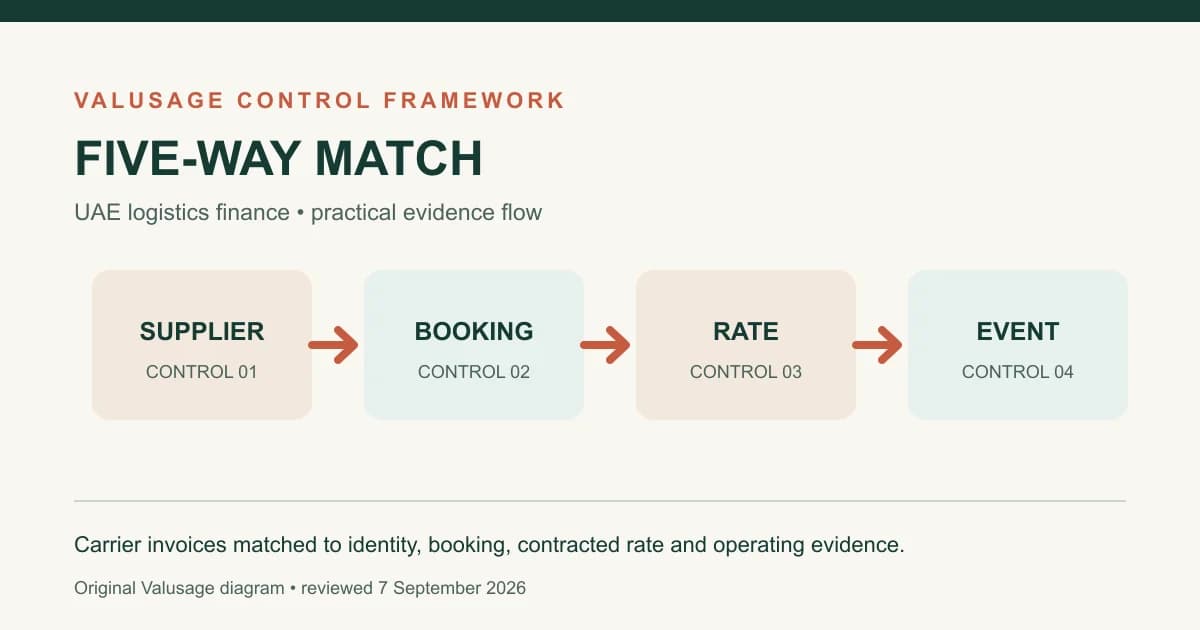
Decision graphic
Carrier invoice five-way reconciliation
Accounts payable control flow
Decision table
Route carrier invoice exceptions
| Exception | Immediate control | Resolution evidence |
|---|---|---|
| No shipment reference | Hold or suspense the line | Approved job mapping |
| Rate or quantity difference | Compare valid agreement and booking | Commercial or operational approval |
| Unquoted accessorial charge | Open recovery and liability review | Event evidence and authorised decision |
| Possible duplicate or missing credit | Block payment and reconcile statement | Supplier confirmation and corrected ledger |
Carrier invoices often arrive after the shipment, contain multiple jobs or use references that differ from the freight system. Paying from an invoice total without rebuilding the shipment-level detail can create duplicate costs, missed liabilities and inaccurate customer margin.
This checklist supports the logistics accounting pillar, the freight job-cost guide and broader accounts-payable controls.
What data should be required before a carrier invoice is posted? Capture the supplier, invoice number and date, currency, tax details, booking or shipment reference, route, mode, service period, charge codes, quantity or weight basis, agreed rate source and operational confirmation. Split multi-shipment invoices into controlled lines rather than posting one undifferentiated total.
Normalise carrier references through an approved cross-reference. Never remove the supplier’s original reference because it may be needed for duplicate detection, disputes and statement reconciliation.
How should contracted rates be matched? Compare base freight and agreed surcharges to the valid contract, quotation, booking confirmation or tariff. Record the applicable period, lane, equipment or weight tier and currency. A generic rate table without version or scope is not sufficient evidence.
Differences should be classified as rate, volume, route, service, fuel or other agreed driver. An authorised commercial exception should be documented rather than hidden by changing the purchase order after the invoice arrives.
How are accessorial charges controlled? Require the charge description, triggering event, shipment evidence, customer-recovery position and approval. Common examples may include storage, waiting, detention, demurrage, re-delivery, documentation or special handling, but terminology varies by carrier and mode.
Flag accessorial charges that were not quoted, repeat across periods, lack operational evidence or cannot be recovered. Finance should not decide operational liability alone; it should keep the financial exception visible until the responsible owner resolves it.
How are duplicate invoices and credits detected? Search by supplier, original invoice number, amount, date, shipment, booking and charge combination. Include credit notes, cancellations and rebills in the test. Duplicate numbers with punctuation or format changes need normalisation without losing the source value.
Hold suspected duplicates before payment. If a duplicate was paid, document recovery, supplier acknowledgement, settlement and ledger correction instead of netting it silently against an unrelated bill.
Why does the carrier statement matter? Reconcile the supplier statement to the accounts-payable subledger. Identify invoices, credit notes, payments and allocations appearing on only one side. Confirm the statement period and account number, and investigate old debit or credit balances.
A zero payable balance in the ledger does not prove completeness if an invoice was never recorded. Statement reconciliation tests the population from the supplier’s perspective.
How should uninvoiced carrier costs be identified? Compare completed or progressed shipments and carrier bookings with received bills. Use approved rate and operational evidence to estimate missing costs under the accounting policy. Track expected invoice dates and reverse or true up each accrual when the actual bill arrives.
Review old accruals and shipments repeatedly closed without bills. The job-costing guide explains how provisional margin should surface these items.
How should VAT evidence be reviewed? Validate the invoice and tax treatment against the actual supply and current FTA requirements. Do not treat a document as a valid tax invoice solely because it contains a tax amount, and do not infer recoverability from payment.
International transport, transport-related, domestic and other charges can require different analysis. Escalate unclear mixed or pass-through arrangements to the responsible tax reviewer.
What should be approved before payment? Confirm supplier identity and bank details under controlled change procedures; invoice uniqueness; shipment and service evidence; rate and quantity; tax review; coding; dispute status; due date; and payment authority. Separate invoice preparation, approval and payment release as far as practical.
After payment, match bank settlement and remittance to the selected invoices. Do not allow a carrier advance or deposit to disappear into ordinary expense without reconciliation.
Professional boundary This is an accounts-payable and management-control checklist, not a determination of contractual carrier liability, tax, customs, legal, sanctions, transport or assurance matters.
Continue the decision
Services, evidence and next steps
Related control guidance
Continue with another evidence-led management review
 Accounting and BookkeepingConsignment Inventory Ownership, Count and Settlement Controls in the UAE →
 Accounting and BookkeepingMaintenance Work Order, Service Receipt, Accrual and Invoice Controls in the UAE →
 Industry GuidancePromotional Discount, Coupon and Co-Funding Reconciliation Controls in the UAE →
 Industry GuidanceReturnable Packaging, Crate and Pallet Deposit Reconciliation Controls in the UAE →
Professional boundary
This article is general information. It is not a filing opinion, legal advice, audit conclusion, investment recommendation or guarantee of authority acceptance or commercial outcome.
What are the three core carrier-invoice matches?+
Match the invoice to the shipment or booking, the approved rate and charge basis, and operational evidence that the service or event occurred.
Does an accounts-payable balance prove all carrier invoices are recorded?+
No. Reconcile carrier statements and completed shipment bookings to find invoices or credits missing from the ledger.
Should disputed accessorial charges be excluded from reporting?+
Keep them visible with a documented status, owner and accounting assessment; do not erase them simply because liability is disputed.
Valusage email updates
Receive related Valusage guidance
Original summaries with official sources and practical context. Confirm by email. Unsubscribe at any time.
Relevant next steps
Connect this guidance to a defined requirement
Contextual advisory review
Build a controlled carrier invoice close
Describe the entity, decision, deadline and evidence available. The service, enquiry and article path accompany the request. No engagement begins until scope, responsibilities, timing, exclusions and fees are agreed in writing.
Review the related service →Contextual enquiry
Build a controlled carrier invoice close
Tell us the outcome, deadline and current position. The selected service context is retained with your request so the right scope can be reviewed.