
Accounting for Logistics Companies in the UAE: Finance Controls by Shipment
By Valusage Technical Practice
Editorial responsibility: Valusage Business Advisors Editorial Practice
Direct answer
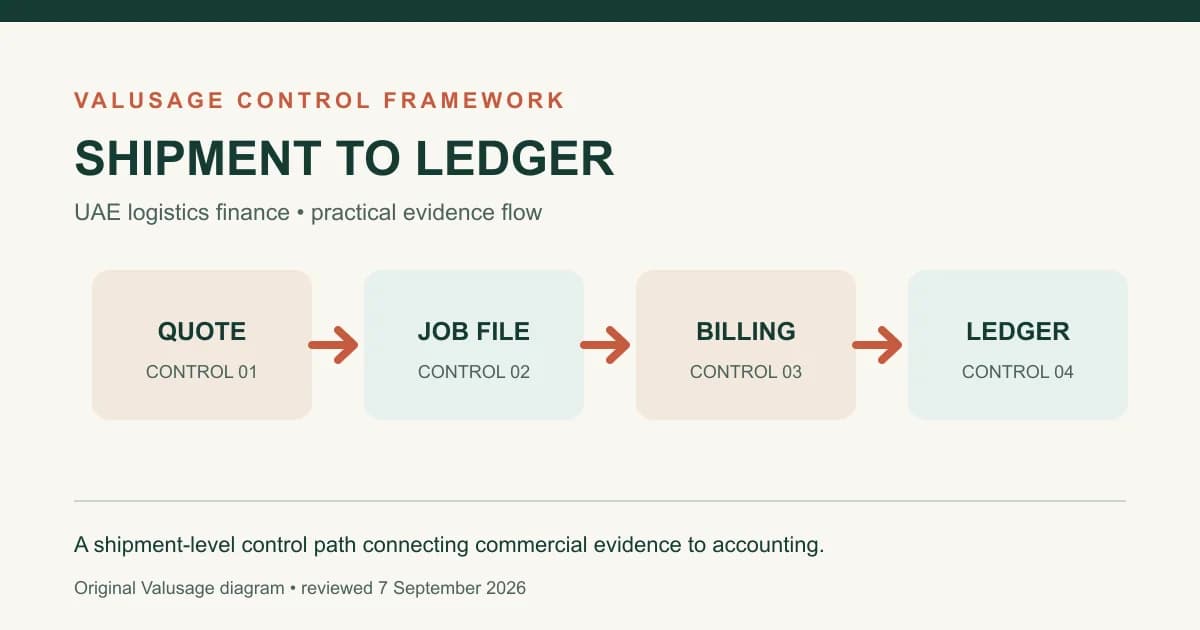
Accounting for a UAE logistics company should use the shipment or job reference as the common finance key from quotation through customer billing and supplier settlement. Finance should distinguish the company’s own revenue and costs from customer-funded disbursements, match carrier and customs evidence to each job, control unbilled and uninvoiced items, reconcile operational files to the general ledger, and report contribution by customer, lane and service without treating estimates as final results.
Decision graphic
UAE logistics shipment-to-ledger control loop
Monthly close workflow
- 1Records
- 2Reconcile
- 3Close
- 4Review
- 5Report
Control coverage
Decision table
Choose the logistics finance control cadence
| Control area | Daily or weekly | Month-end |
|---|---|---|
| Jobs and quotes | Find missing references and amendments | Lock the job population and approved economics |
| Supplier and customs costs | Match bills, statements and receipts | Accrue and reconcile uninvoiced items |
| Billing and cash | Test bill-ready jobs and unapplied receipts | Tie invoices, receivables and bank |
| Margin and tax | Flag provisional loss-making jobs | Approve evidence, tax decisions and dashboard |
Logistics businesses can show healthy revenue while losing margin through missed carrier bills, unbilled accessorial charges, customs advances, currency differences or jobs closed before every document arrives. The accounting design should therefore follow the shipment lifecycle rather than rely only on supplier or customer ledgers.
This pillar links the full model to three focused guides: freight-forwarding job costing, carrier-invoice reconciliation and a shipment profitability dashboard.
What should the logistics finance data model contain? Maintain stable identifiers for the legal entity, branch, customer, shipment, quotation, route, mode, origin, destination, carrier, customs declaration where relevant, supplier bill, customer invoice, receipt, payment and ledger account. Preserve the relationship between master shipment, house shipment and consolidated movement if the operating model uses those levels.
Define who can create or change each identifier. Operations may own shipment status and documents; finance owns posted transactions, reconciliations and period locks. Free-text job references create duplicate or orphaned balances and should be exception reports, not accepted practice.
How should a quote become an accounting job? Freeze the approved commercial quote, currency, expected revenue, expected direct cost, charge codes and margin threshold when the job is accepted. Record approved amendments rather than overwriting the original economics. Link the customer order or service instruction and the responsible commercial owner.
Expected values support control and forecasting, but they are not automatically ledger amounts. Accounting recognition follows the contract, performance and approved policy; cash collection, invoice timing and physical movement are separate events.
How should shipment costs be captured? Require every carrier, agent, handling, storage, documentation, inspection or other direct-cost item to carry a valid shipment reference and approved charge code. Match the supplier, service period, currency, quantity or basis, tax evidence and operational confirmation before posting or payment.
Use the carrier-invoice reconciliation guide for statement completeness, duplicate detection and accessorial-charge review. Costs without a job reference should remain visible in a suspense workflow with an owner and ageing.
How should customs payments and customer disbursements be separated? A payment to a customs authority, port, agent or other party does not by itself determine whether the amount is the company’s expense, a recoverable customer-funded amount, part of its own service price or another balance. Record the payer, legal obligor, declaration, shipment, customer authority, supporting receipt, reimbursement terms and final settlement.
Maintain a separate reconciliation for customs-related advances and reimbursements, supported by the authority receipt and shipment record. Customs treatment is authority- and fact-specific; escalate interpretation rather than inferring a nationwide rule.
How should billing completeness be tested? Compare the closed or billable shipment population to issued customer invoices and credit notes. Test every approved charge code, pass-through or disbursement, surcharge and agreed adjustment. Investigate completed jobs without invoices, invoices without shipment evidence, duplicate invoices and jobs whose actual cost exceeds the quote without an approved commercial response.
Use a controlled bill-ready status with named operational and finance approvals. A system-generated invoice is not proof that every recoverable charge was included.
How should VAT and Corporate Tax evidence be handled? Determine tax treatment from the actual supply, parties, route, contract and current FTA rules. International transport, transport-related services, domestic legs, exports, imports, connected delivery, disbursements and recharges may not share one outcome. Link the decision to valid tax invoices or other required evidence and the return working paper.
The FTA’s Free Zone Persons guide discusses logistics services in the qualifying-activity framework. That does not mean every logistics entity or every receipt qualifies for a particular rate. Entity status, substance, customers, activities, income and other conditions require fact-specific review.
What belongs in the month-end close? Reconcile open operational jobs to open finance jobs; expected cost to supplier bills and accruals; completed jobs to billing; customer invoices to receivables and collections; customs or other advances to supporting declarations and reimbursements; and all job balances to the general ledger.
Review negative-margin jobs, old unbilled revenue, old uninvoiced cost, unmatched cash, unmatched carrier statements, foreign-currency exposures and reopened jobs. Each exception needs a reason, owner and due date.
What should management receive? Present shipment volumes and service mix beside billed revenue, direct cost, contribution, unbilled items, uninvoiced costs, customs advances, receivables, cash conversion and forecast variance. Segment only on reconciled dimensions such as customer, lane, branch, mode and salesperson.
The shipment profitability dashboard explains denominator controls and drill-down evidence. Use Valusage Insights for broader close, receivables and working-capital guidance.
Professional boundary This is an accounting and internal-control framework, not customs, freight, transport, legal, tax, licensing, sanctions, trade-compliance or assurance advice. Requirements depend on the emirate, authority, route, goods, contract, Incoterms, licence and operating role.
Continue the decision
Services, evidence and next steps
Related control guidance
Continue with another evidence-led management review
 Accounting and BookkeepingConsignment Inventory Ownership, Count and Settlement Controls in the UAE →
 Accounting and BookkeepingMaintenance Work Order, Service Receipt, Accrual and Invoice Controls in the UAE →
 Industry GuidancePromotional Discount, Coupon and Co-Funding Reconciliation Controls in the UAE →
 Industry GuidanceReturnable Packaging, Crate and Pallet Deposit Reconciliation Controls in the UAE →
Professional boundary
This article is general information. It is not a filing opinion, legal advice, audit conclusion, investment recommendation or guarantee of authority acceptance or commercial outcome.
What is the core accounting unit for a logistics company?+
The shipment or job reference should connect the quote, operational evidence, supplier costs, customs-related amounts, customer billing, cash and ledger entries.
Are customs payments always an expense of the freight forwarder?+
No. The accounting depends on who is legally obliged, the customer arrangement, evidence and approved accounting and tax analysis.
Should every completed shipment show a final margin immediately?+
Only after billing completeness, supplier-cost completeness and required estimates have been reviewed. Otherwise label the result provisional.
Valusage email updates
Receive related Valusage guidance
Original summaries with official sources and practical context. Confirm by email. Unsubscribe at any time.
Relevant next steps
Connect this guidance to a defined requirement
Contextual advisory review
Build a shipment-controlled logistics close
Describe the entity, decision, deadline and evidence available. The service, enquiry and article path accompany the request. No engagement begins until scope, responsibilities, timing, exclusions and fees are agreed in writing.
Review the related service →Contextual enquiry
Build a shipment-controlled logistics close
Tell us the outcome, deadline and current position. The selected service context is retained with your request so the right scope can be reviewed.