
Logistics Shipment Profitability Dashboard for UAE Management Teams
By Valusage Technical Practice
Editorial responsibility: Valusage Business Advisors Editorial Practice
Direct answer
A UAE logistics profitability dashboard should report reconciled shipment revenue, direct cost and contribution alongside volume, mode, lane, customer, branch and salesperson dimensions. It must distinguish forecast, provisional and final job margin; show unbilled revenue, uninvoiced carrier costs, customs advances, disputes and receivables; define every denominator; and let management drill each KPI back to the shipment, invoice, supplier bill, accrual and bank evidence.
Decision graphic
UAE logistics profitability control dashboard
13-week cash outlook
First 90 days
Decision table
Interpret logistics profitability signals
| Signal | Likely question | Required drill-down |
|---|---|---|
| Revenue up; contribution down | Pricing or cost leakage? | Quote, rate, accessorial and carrier-cost bridge |
| Margin strong; many provisional jobs | Are costs incomplete? | Uninvoiced bills and accrual evidence |
| Customer profitable; cash weak | Is credit absorbing value? | Receivables, disputes and customs advances |
| Lane loss concentrated | Structural or one-off issue? | Job population, volume, route and currency effects |
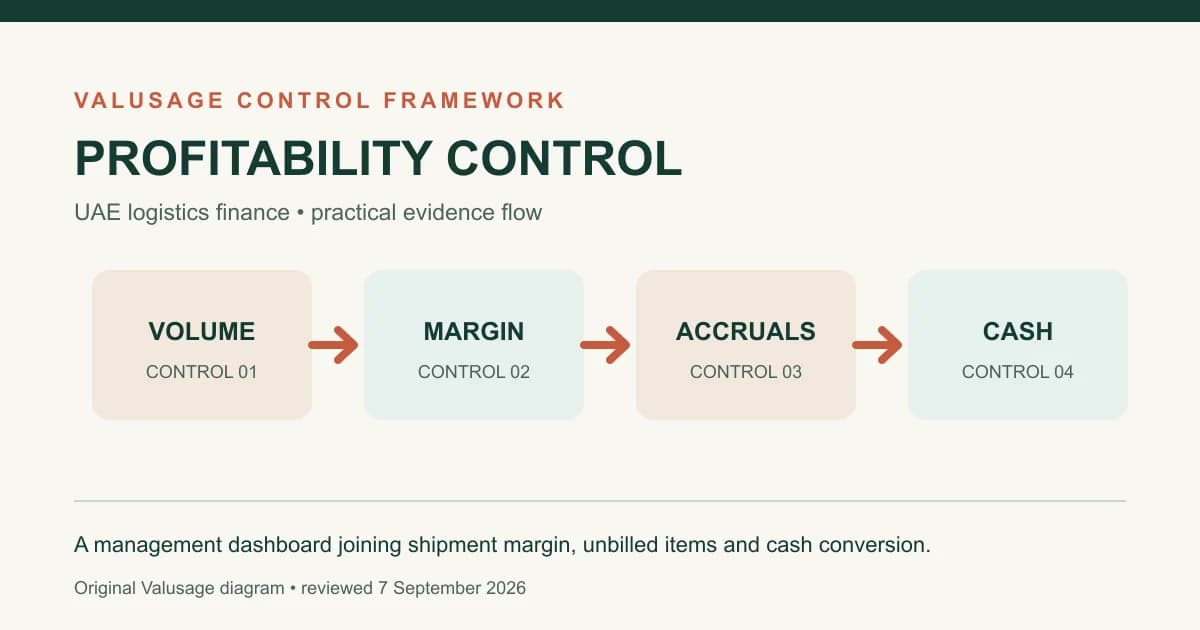
A logistics dashboard can reward revenue growth while hiding loss-making shipments, incomplete costs and delayed customer billing. The useful view connects operational volume to reconciled finance and makes the quality of each margin result visible.
This guide supports the logistics accounting pillar, freight job costing and carrier-invoice reconciliation.
Which headline measures should the dashboard show? Show shipment count, billed revenue, recognised revenue under policy, direct job cost, contribution, contribution percentage, average contribution per shipment, negative-margin jobs, unbilled items, uninvoiced costs, customs or other advances, receivables and cash collected.
Keep each measure’s population and period explicit. Shipment count might mean created, departed, arrived, completed, billed or closed; mixing statuses makes comparisons unreliable.
How should forecast, provisional and final margin differ? Forecast margin uses approved quote and expected-cost data. Provisional margin uses available actuals plus controlled estimates while material items remain open. Final margin follows approved billing and cost-completeness tests and a locked job.
Display the mix of statuses and the age of provisional jobs. A high reported margin based mainly on unbilled or uninvoiced estimates deserves a quality warning.
Which dimensions support decisions? Common dimensions include legal entity, branch, customer, service, air or sea or road mode, origin-destination lane, shipment type, carrier, salesperson and month. Only use dimensions with governed master data and sufficient completeness.
Avoid publishing a customer or salesperson league table if jobs are assigned inconsistently or shared costs are applied selectively. Provide an unassigned category instead of silently excluding incomplete records.
How should customer profitability be calculated? Start with shipment contribution and separately disclose approved shared-cost allocations where used. Reconcile customer revenue, direct cost, accessorial leakage, credit notes, disputes, receivables and collection timing. Define whether customs or other pass-through amounts are included.
Customer profitability is not the same as revenue ranking. A high-volume customer may consume credit, operational exceptions or unrecovered costs that are invisible in sales totals.
How should lane and service profitability be used? Compare comparable service and shipment populations. Use volume, weight or other operational denominators only when controlled and relevant. Show the number of jobs, revenue, direct cost, contribution and margin-quality status for each segment.
Small samples, exceptional projects and currency movements should be labelled. Do not infer a permanent pricing decision from one outlier month without operational context.
Which working-capital measures matter? Track days or ageing for customer receivables, unbilled jobs, uninvoiced carrier costs, customs advances, unapplied receipts and disputed amounts. Relate the measures to operational stages and owners rather than presenting only a closing balance.
The broader working-capital dashboard guide explains cash-cycle governance. In logistics, shipment and declaration references provide the operational drill-down.
How should data quality appear on the dashboard? Include missing shipment references, duplicate job IDs, bills without jobs, closed jobs with open costs, completed jobs without billing, manual journals, old accruals, unmatched carrier statements and unreconciled customs movements.
A KPI pack should disclose excluded records and refresh timing. Green charts are not credible when unresolved records sit outside the dataset.
What review cadence should management use? Operations may review bill-ready, carrier-cost and customs exceptions daily or weekly. Finance should lock the monthly population, reconcile it to the general ledger and approve status changes. Commercial teams should review quote-to-actual and recovery leakage with evidence.
Record decisions, owners and due dates. The dashboard is the meeting input; it is not a substitute for resolving the exception.
How should VAT and compliance measures be presented? Show document or decision exceptions rather than claiming the dashboard determines tax treatment. Possible measures include supplier invoices awaiting validation, customer invoices with open tax-code review and shipments missing required evidence under the approved process.
Tax outcomes depend on facts and current FTA rules. Use the dashboard to route work to the responsible reviewer, not to automate unsupported conclusions.
Professional boundary This is a management-reporting framework, not a valuation, audit, assurance, tax, customs, freight, pricing, sanctions, trade-compliance or legal conclusion.
Continue the decision
Services, evidence and next steps
Related control guidance
Continue with another evidence-led management review
 Accounting and BookkeepingConsignment Inventory Ownership, Count and Settlement Controls in the UAE →
 Accounting and BookkeepingMaintenance Work Order, Service Receipt, Accrual and Invoice Controls in the UAE →
 Industry GuidancePromotional Discount, Coupon and Co-Funding Reconciliation Controls in the UAE →
 Industry GuidanceReturnable Packaging, Crate and Pallet Deposit Reconciliation Controls in the UAE →
Professional boundary
This article is general information. It is not a filing opinion, legal advice, audit conclusion, investment recommendation or guarantee of authority acceptance or commercial outcome.
What is the most important quality indicator in a logistics margin dashboard?+
Show how much margin is forecast, provisional or final and expose the unresolved billing and supplier-cost items behind provisional results.
Should customs and other pass-through amounts be included in revenue KPIs?+
Define and consistently apply the approved presentation after reviewing the arrangement; do not mix gross and net populations across customers or periods.
How should management investigate a negative-margin segment?+
Drill from customer or lane to shipment, then to quote, amendments, invoices, supplier bills, accruals, accessorial charges and collections.
Valusage email updates
Receive related Valusage guidance
Original summaries with official sources and practical context. Confirm by email. Unsubscribe at any time.
Relevant next steps
Connect this guidance to a defined requirement
Contextual advisory review
Build a shipment-level profitability pack
Describe the entity, decision, deadline and evidence available. The service, enquiry and article path accompany the request. No engagement begins until scope, responsibilities, timing, exclusions and fees are agreed in writing.
Review the related service →Contextual enquiry
Build a shipment-level profitability pack
Tell us the outcome, deadline and current position. The selected service context is retained with your request so the right scope can be reviewed.