
Payment Gateway Reconciliation for UAE E-Commerce Businesses
By Valusage Technical Practice
Editorial responsibility: Valusage Business Advisors Editorial Practice
Direct answer
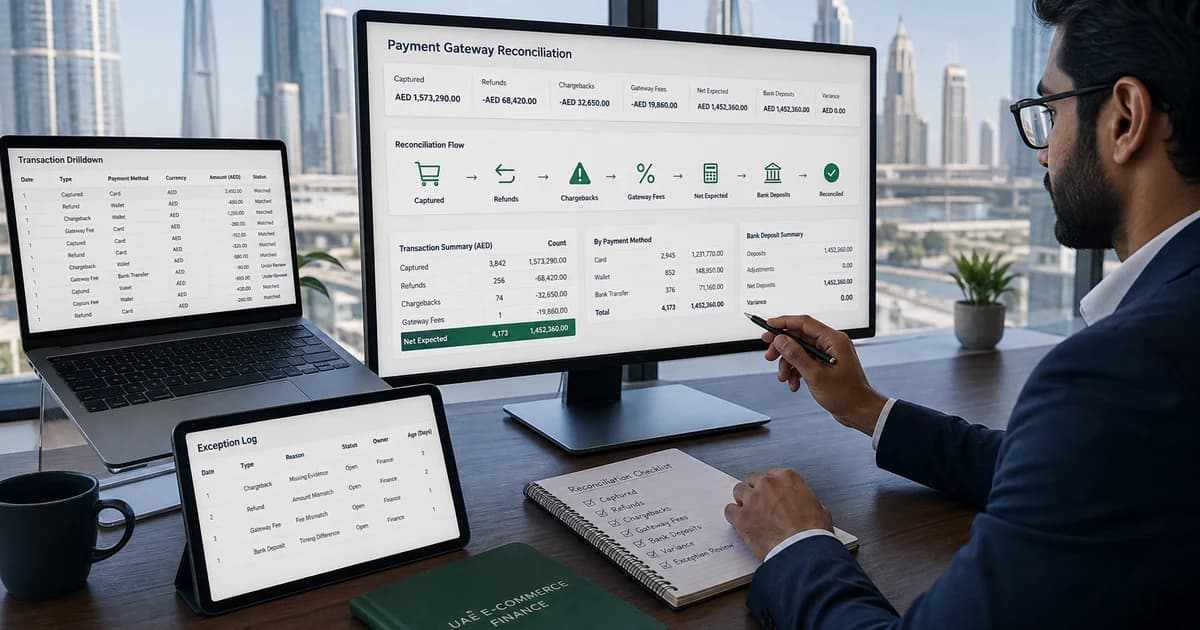
A UAE e-commerce business should reconcile payment gateways at transaction level: authorised and captured payments to completed orders, captured totals to gateway batches, batches to bank deposits, and refunds, chargebacks, fees, reserves and foreign-exchange movements to separate ledger accounts. Failed, duplicated, delayed or manually adjusted transactions should remain in an aged exception queue until evidence supports clearance.
Decision graphic
Payment gateway three-way reconciliation
Monthly close workflow
- 1Records
- 2Reconcile
- 3Close
- 4Review
- 5Report
Control coverage
Decision table
Resolve common gateway exceptions
| Exception | Evidence to inspect | Accounting control |
|---|---|---|
| Captured, not paid | Payout batch and value date | Age in gateway clearing |
| Paid, no order | Gateway reference and order log | Investigate duplicate or mapping failure |
| Refund or dispute | Original capture and case evidence | Track status in separate control |
| Unexpected fee or FX | Agreement, invoice and currency report | Validate rate, tax and posting |
A gateway report sits between the customer checkout and the bank. It may include authorisations that never captured, partial captures, retries, refunds, chargebacks, rolling reserves, fees and currency conversion. A bank-only reconciliation misses those states.
Which gateway reports should finance retain? Keep transaction, payout, fee, refund, dispute, reserve and foreign-exchange reports together with the merchant agreement and bank statement. The transaction export should include gateway reference, order reference, status, amount, currency, timestamps and payment method without retaining unnecessary sensitive card data.
Use access controls and the provider's approved reports. Accounting teams should not collect full card credentials.
What is the correct three-way match? First match completed orders to successful captures. Second match captured transactions to gateway payout batches after refunds, disputes, fees and reserves. Third match the expected payout to the bank value. The gateway clearing account should explain transactions captured but not yet paid.
Control totals should show counts and values at every stage. Differences need stable references rather than free-text descriptions.
How should failed and duplicate payments be treated? Authorisations, declines and abandoned checkouts are not automatically sales or receivables. Review the order state and capture evidence. Detect duplicate capture references, repeated retry amounts and orders with more than one successful payment. Refund or liability decisions should follow approved procedures.
A manual write-off should not replace gateway investigation merely because the amount is small; use a documented materiality and recurrence policy.
How are refunds and chargebacks reconciled? Link each refund or dispute to the original payment, order, invoice or credit-note evidence and customer communication. Separate submitted, accepted, rejected and recovered disputes. Where the gateway withholds cash before a case is resolved, record the movement according to the approved accounting policy and track the case outcome.
Refund timing may differ from the accounting period of the original sale. Keep that timing visible in the clearing and refund control accounts.
How should fees, reserves and currencies be posted? Post transaction fees, fixed charges, dispute charges and currency conversion separately from sales. Roll forward any reserve from opening balance through additions, releases and closing balance. For multi-currency activity, distinguish transaction currency, settlement currency and ledger currency, and identify the source of each exchange rate.
Review tax-invoice evidence and VAT treatment for gateway services using current FTA guidance and the specific supplier and place-of-supply facts.
What are the strongest automated controls? Use unique gateway and order keys, state-transition rules, duplicate detection, expected-fee tests, batch-to-bank matching, refund-to-original-payment links, dispute ageing and protected mapping tables. Automation should log missing or rejected records and prevent silent overwrites.
A reconciliation is not complete when a script runs; it is complete when the reviewer can explain the residual balance.
What should month-end sign-off include? Sign off the transaction population, capture-to-order match, payout-to-bank match, clearing-account ageing, refunds, disputes, reserves, fees, foreign exchange, manual journals and VAT evidence. Compare the balance with prior periods and investigate unusual ageing or loss rates.
Connect the result to channel profitability rather than treating gateway costs as an undifferentiated bank charge.
Professional boundary Providers, acquiring arrangements, currencies and dispute rules differ. This guide is an accounting-control framework; it does not provide payment-security certification, contractual, legal or fact-specific tax advice.
Continue the decision
Services, evidence and next steps
Related control guidance
Continue with another evidence-led management review
 Accounting and BookkeepingConsignment Inventory Ownership, Count and Settlement Controls in the UAE →
 Accounting and BookkeepingMaintenance Work Order, Service Receipt, Accrual and Invoice Controls in the UAE →
 Industry GuidancePromotional Discount, Coupon and Co-Funding Reconciliation Controls in the UAE →
 Industry GuidanceReturnable Packaging, Crate and Pallet Deposit Reconciliation Controls in the UAE →
Professional boundary
This article is general information. It is not a filing opinion, legal advice, audit conclusion, investment recommendation or guarantee of authority acceptance or commercial outcome.
What is a payment gateway clearing account?+
It tracks successful captures and related adjustments that have not yet appeared in the bank, allowing timing items to be aged and explained.
Should failed authorisations be posted as revenue?+
Not automatically. Confirm the order and capture status; an authorisation or declined checkout is not evidence of a completed sale.
How should chargebacks be monitored?+
Link each case to the original payment and order, separate case statuses and withheld cash, retain evidence, and age unresolved exposures until final resolution.
Valusage email updates
Receive related Valusage guidance
Original summaries with official sources and practical context. Confirm by email. Unsubscribe at any time.
Relevant next steps
Connect this guidance to a defined requirement
Contextual advisory review
Build an order-to-cash gateway reconciliation
Describe the entity, decision, deadline and evidence available. The service, enquiry and article path accompany the request. No engagement begins until scope, responsibilities, timing, exclusions and fees are agreed in writing.
Review the related service →Contextual enquiry
Build an order-to-cash gateway reconciliation
Tell us the outcome, deadline and current position. The selected service context is retained with your request so the right scope can be reviewed.