
Bank Reconciliation Checklist for UAE Businesses
By Valusage Technical Practice
Editorial responsibility: Valusage Business Advisors Editorial Practice
Direct answer
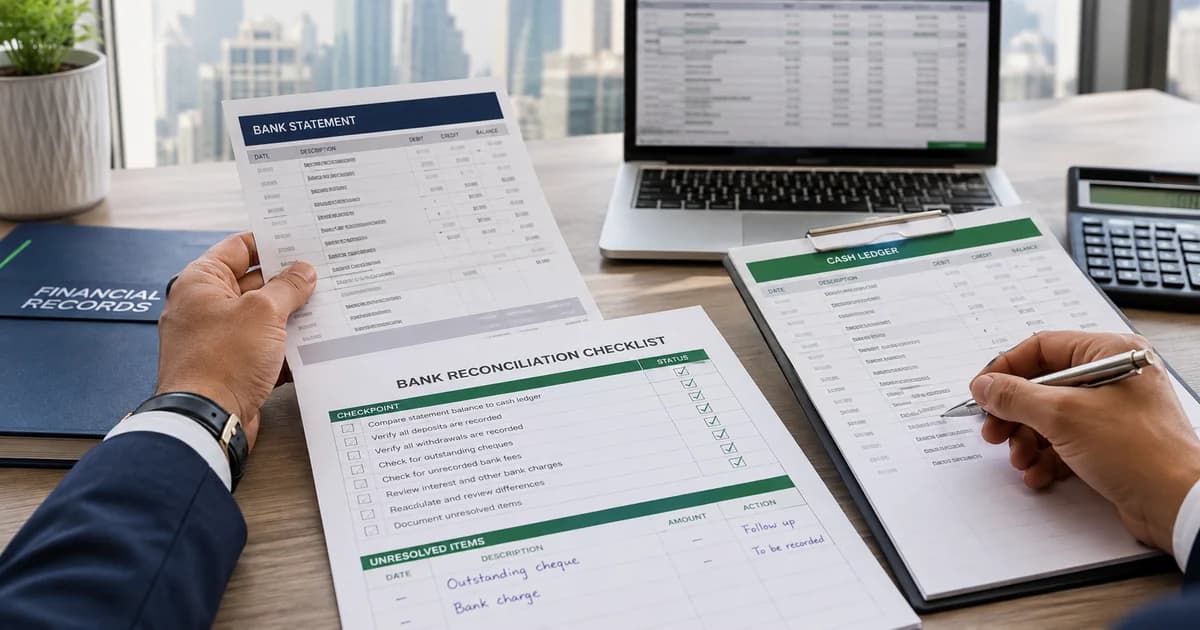
A complete bank reconciliation matches the ledger balance to the bank statement for every account, explains all timing differences, investigates unknown transactions, clears duplicates, records approved adjustments and carries forward only supported outstanding items. The reconciliation should show preparer, reviewer, completion date and evidence links, then feed the month-end close and management reporting pack.
Decision graphic
Reconcile every cash account through a controlled close
Monthly close workflow
- 1Records
- 2Reconcile
- 3Close
- 4Review
- 5Report
Control coverage
Decision table
Bank-reconciliation exception decisions
| Exception | Evidence | Reviewer question | Next action |
|---|---|---|---|
| Unidentified receipt | Statement narrative and customer ledger | Can the source and obligation be established? | Hold in a controlled account and investigate |
| Unpresented payment | Payment approval and later clearing | Is the item valid, current and correctly dated? | Clear, reverse or escalate |
| One-sided transfer | Both bank statements and journal | Was the transfer posted completely and in the right period? | Correct with approved support |
| Old reconciling item | Prior reconciliations and correspondence | Why has the item not cleared? | Assign owner and resolution deadline |
Bank reconciliation is a control over cash, posting completeness and period cut-off. A statement balance and ledger balance can agree while duplicate, offsetting or misclassified transactions remain hidden, so the review must test the movement as well as the closing total.
What should be reconciled? Include every operating, savings, card, merchant, loan and restricted-cash account in the entity's control. Confirm the account list against bank confirmations, online-banking access and the chart of accounts. Dormant or closed accounts should have documented status rather than disappearing from the checklist.
How should the reconciliation begin? Obtain the complete statement for the period and record the opening balance, receipts, payments, bank charges, interest, transfers and closing balance. Compare the statement movement with the ledger, then separate genuine timing items from missing or incorrect postings.
Which exceptions require investigation? Investigate unidentified receipts, stale cheques, duplicate payments, direct debits without support, bank fees not posted, transfers recorded on one side only and entries dated into the wrong period. Each exception needs an owner, evidence and target resolution date.
What should the reviewer test? The reviewer should confirm statement completeness, independently inspect significant and unusual items, recalculate the bridge, review post-period clearing and verify that journal entries have approval and support. The same person should not prepare, approve and post every correction without an explicit compensating control.
How does this support UAE record keeping? UAE company legislation requires accounting records that explain transactions and financial position and generally requires companies to keep accounting records at headquarters for at least five years after the relevant financial year. Separate tax rules may require longer retention. A dated reconciliation with linked evidence supports that broader record trail.
Professional boundary This checklist is a management-accounting control, not an audit procedure or assurance conclusion. The appropriate frequency, thresholds and segregation of duties depend on account risk, transaction volume and the entity's operating model.
Related control guidance
Continue with another evidence-led management review
 Accounting and BookkeepingConsignment Inventory Ownership, Count and Settlement Controls in the UAE →
 Accounting and BookkeepingMaintenance Work Order, Service Receipt, Accrual and Invoice Controls in the UAE →
 Industry GuidancePromotional Discount, Coupon and Co-Funding Reconciliation Controls in the UAE →
 Industry GuidanceReturnable Packaging, Crate and Pallet Deposit Reconciliation Controls in the UAE →
Professional boundary
This article is general information. It is not a filing opinion, legal advice, audit conclusion, investment recommendation or guarantee of authority acceptance or commercial outcome.
What should a bank reconciliation contain?+
It should show the statement and ledger balances, supported timing differences, corrections, unresolved-item owners, evidence links, preparer, reviewer and completion date for every controlled account.
How often should a UAE business reconcile bank accounts?+
High-activity or high-risk accounts may need daily or weekly monitoring, while every controlled account should enter a defined month-end close process. The cadence should reflect risk, volume and management needs.
Is a bank reconciliation the same as an audit?+
No. It is an internal accounting control. It does not provide an audit opinion or assurance conclusion.
Valusage email updates
Receive related Valusage guidance
Original summaries with official sources and practical context. Confirm by email. Unsubscribe at any time.
Relevant next steps
Connect this guidance to a defined requirement
Contextual advisory review
Review bank reconciliations and unresolved cash items
Describe the entity, decision, deadline and evidence available. The service, enquiry and article path accompany the request. No engagement begins until scope, responsibilities, timing, exclusions and fees are agreed in writing.
Review the related service →Contextual enquiry
Review bank reconciliations and unresolved cash items
Tell us the outcome, deadline and current position. The selected service context is retained with your request so the right scope can be reviewed.