
Month-End Close Task Dependency and Handover Controls for UAE Finance Teams
By Valusage Technical Practice
Editorial responsibility: Valusage Business Advisors Editorial Practice
Direct answer
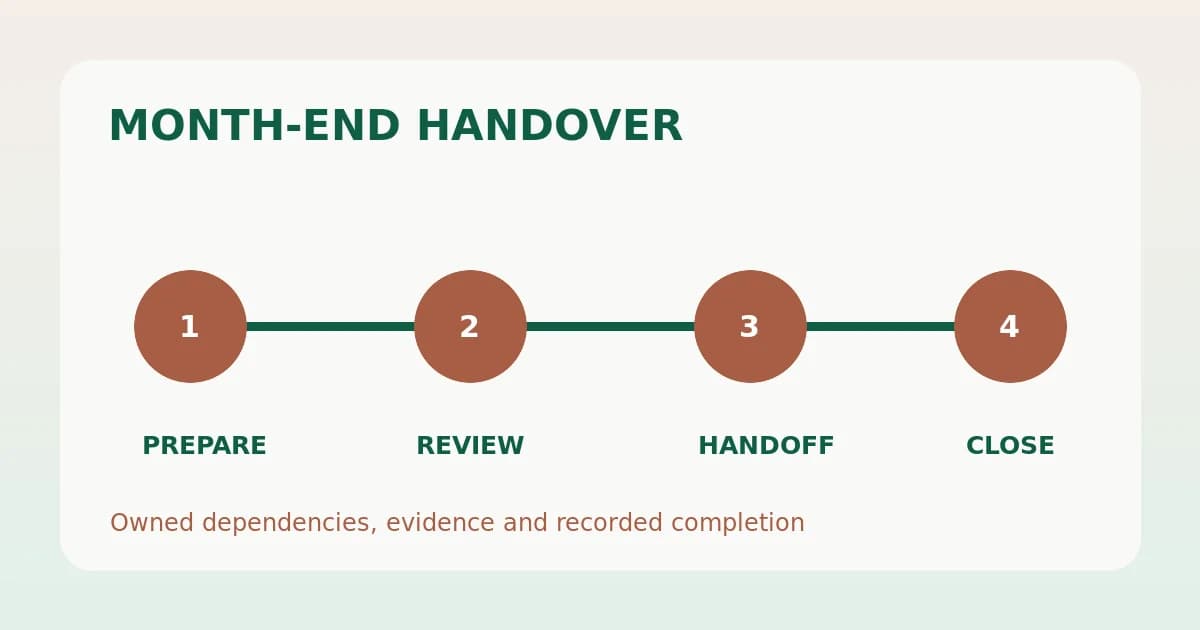
A UAE finance team should map each month-end close task to its prerequisite, preparer, reviewer, evidence, due time and downstream recipient. A task should not be treated as complete merely because work started or a file was uploaded; the required evidence should be handed over and accepted by the next owner. Delays and incomplete handovers should remain visible until resolved or approved as an exception.
Accounting close map
From information to a controlled decision
- 01Capture
- 02Reconcile
- 03Close
- 04Report
Illustrative evidence trend
Decision supportA close calendar can appear green while downstream work is still blocked. Dependency controls connect completion to the evidence another person needs, not only to the preparer's own status update.
Map the dependency chain
Identify which tasks rely on bank files, inventory counts, payroll inputs, supplier invoices, revenue cut-off, intercompany confirmations and approved journals. Record the earliest start, required predecessor and downstream report affected by delay.
Define completion evidence
For each task, state what proves completion: a reconciled schedule, approved journal, system report, signed count, exception log or reviewer confirmation. Avoid vague statuses such as "done" when the final file or approval is missing.
Control the handover
Name the sender and recipient, file location, version, handover time and acceptance status. The recipient should be able to reject an incomplete handover with a clear reason. Preserve the revised submission rather than silently replacing the original evidence.
Manage blockers
Record the blocked task, cause, owner, expected resolution and affected outputs. Distinguish an approved estimate or controlled exception from missing work. Escalate items that threaten reporting quality or release timing.
Close the cycle
After release, review late handovers, rework and repeated dependencies. Update the calendar, responsibilities or system workflow where evidence shows the design is unrealistic. Keep the final close record linked to the released reporting version.
Practical checklist
1. Map predecessors and downstream consumers. 2. Define evidence for every completion status. 3. Name sender, reviewer and recipient. 4. Record version and handover time. 5. Allow documented rejection of incomplete work. 6. Keep blockers visible to closure. 7. Preserve exceptions and approvals. 8. Improve repeat delays after each close.
IAS 1 and the IFRS Conceptual Framework support understandable and faithfully represented information, while UAE Commercial Companies legislation requires accounting records that explain transactions. This workflow does not determine the accounting treatment of a specific item.
About the author
Haris Arif is Head of Finance and Investment. He is a finance and investment leader with experience across multi-entity businesses in technology, F&B and hospitality. He writes practical insights on financial control, management reporting, working capital, tax readiness and finance transformation for UAE founders, CFOs, investors and management teams.
Connect with Haris Arif on LinkedIn: https://www.linkedin.com/in/harisarifofficial/
Continue the decision
Services, evidence and next steps
Related control guidance
Continue with another evidence-led management review
 Technology and eInvoicingFinance-System Access Recertification and Leaver Controls in the UAE →
 Technology and eInvoicingShared Spreadsheet Formula-Change and Protection Controls for UAE Finance Teams →
 CFO, Finance and Cash FlowTreasury Bank-Mandate and Signatory Lifecycle Controls for UAE Businesses →
 Accounting and BookkeepingAudit Evidence and PBC Request Tracker Controls for UAE Finance Teams →
Professional boundary
This article is general information. It is not a filing opinion, legal advice, audit conclusion, investment recommendation or guarantee of authority acceptance or commercial outcome.
What makes a close task complete?+
Completion should require the defined evidence, review and handover needed by the downstream owner.
How should a blocked task be recorded?+
Record the cause, owner, expected resolution, affected reports and whether a controlled exception was approved.
Should a rejected handover disappear?+
No. Preserve the rejection, reason and revised submission so rework remains traceable.
Valusage email updates
Receive related Valusage guidance
Original summaries with official sources and practical context. Confirm by email. Unsubscribe at any time.
Relevant next steps
Connect this guidance to a defined requirement
Contextual advisory review
Turn every close status into an evidenced handover accepted by the next owner
Describe the entity, decision, deadline and evidence available. The service, enquiry and article path accompany the request. No engagement begins until scope, responsibilities, timing, exclusions and fees are agreed in writing.
Review the related service →Contextual enquiry
Turn every close status into an evidenced handover accepted by the next owner
Tell us the outcome, deadline and current position. The selected service context is retained with your request so the right scope can be reviewed.